

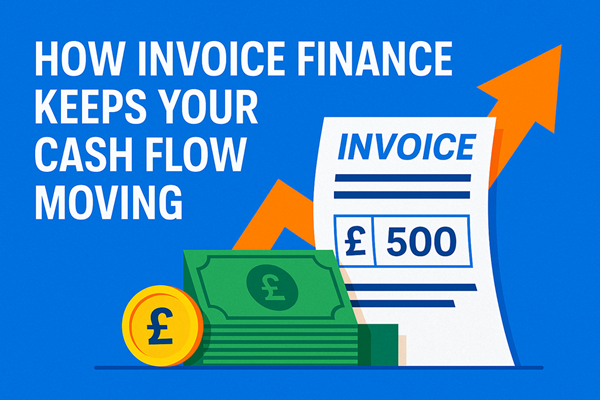
How Invoice Finance Helps Keep Cash Flow Steady
If there’s one thing nearly every business owner moans about, it’s waiting to get paid. You deliver the work, you send the invoice, and then you’re stuck refreshing your bank account like a bad habit. Meanwhile, bills don’t wait, staff need paying, and opportunities pass because your cash is tied up in someone else’s bank account. That’s exactly where invoice finance steps in and it’s far more straightforward than people think.
So, what actually is invoice finance?
At its core, invoice finance lets you unlock most of the value of an unpaid invoice almost immediately. Instead of waiting 30, 60 or even 90 days for the customer to pay, a finance provider advances you around 85 – 90% of the invoice value upfront. When the customer finally pays, you get the remaining balance minus the provider’s fee.
It’s your money, just earlier.

No mystery, no long-winded jargon. Just cash flow without the drama.
Why do businesses choose invoice finance?
Because cash flow issues don’t mean your business is struggling, they usually mean you’re busy. Growing businesses often hit cash gaps precisely because they’re successful. More orders, more staff, more materials, more invoices… and more waiting.
Invoice finance is popular for businesses in:
- Recruitment
- Manufacturing
- Wholesale
- Construction-related services
- Logistics
- Professional services
Basically, anyone who deals with B2B invoices and has customers who pay on terms.
Let’s talk real examples
Here are a few situations where invoice finance genuinely makes life easier:
1. A recruitment agency covering contractor wages
A recruitment firm placing 10 contractors may need to pay those workers weekly, while the client pays every 45 days. Invoice finance covers wages upfront, so the firm doesn’t need tens of thousands sitting idle.
2. A manufacturer waiting on a supermarket invoice
Large retailers are notorious for long payment terms. A small manufacturer supplying a supermarket can get paid within days instead of months and keep production moving without scrambling for cash.
3. A logistics provider handling a big seasonal spike
Couriers and haulage companies often have spikes around Christmas or summer. More deliveries mean more fuel, more drivers, more overtime. Invoice finance keeps the wheels turning without taking on expensive short-term loans.
How it actually works day-to-day
Most providers give you access to an online portal where you upload invoices. Funding usually lands within 24 hours. Some products even automate the process, so invoices are funded as soon as they’re raised.
Two main types exist:
- Invoice factoring: Provider helps chase payments
- Invoice discounting: You keep control of collections
Discounting feels more discreet; factoring is helpful if you hate debt-chasing.
The benefits
- You get paid faster, simple as that
- Cash flow stops being a monthly headache
- You can take on bigger clients without panicking
- It grows with your sales
- Banks don’t control your timeline
If you want consistent, predictable cash without giving away equity or taking out big loans, this is a very practical tool.
When invoice finance makes sense
If you’re growing quickly, dealing with slow payers, or constantly juggling payroll and supplier payments, invoice finance fits. It’s not ideal for businesses paid upfront or those with tiny, infrequent invoices.
But for B2B companies who deliver great work and wait too long to see the money, it’s a solid, flexible solution that lets you focus on running your business instead of chasing payments.
Final thought
Cash flow shouldn’t hold you back. If you’ve earned the money, you deserve to access it. Invoice finance helps you do exactly that, without turning your life upside down.
Recent Posts

What Does a Commercial Finance Broker Do?
March 5, 2026

Can I Borrow Money to Open a Business? A Practical UK Guide
February 25, 2026

Merchant Finance Loan Requirements: What UK Businesses Need to Know
February 24, 2026

Categories
- Asset Finance (14)
- Business Loans (10)
- Commercial Finance (11)
- Construction Finance (6)
- Finance (4)
- Franchise Finance (3)
- Invoice Finance (12)
- Merchant Finance (20)
- Trade Finance (2)
- Unsecured Loans (4)


 21 Rotherwick Road, London, NW11 7DG


